How delivery routes, dispatch logistics, courier networks, and last-mile systems move sandwiches from kitchen to customer across the United States.
Transport is the final and often most publicly visible component of the sandwich delivery system. It encompasses everything from the moment a courier picks up a packaged order at the kitchen counter to the moment it is handed to the customer. In between those two points lies a sophisticated web of technology, human coordination, route mathematics, and physical infrastructure that defines the modern US food delivery landscape.
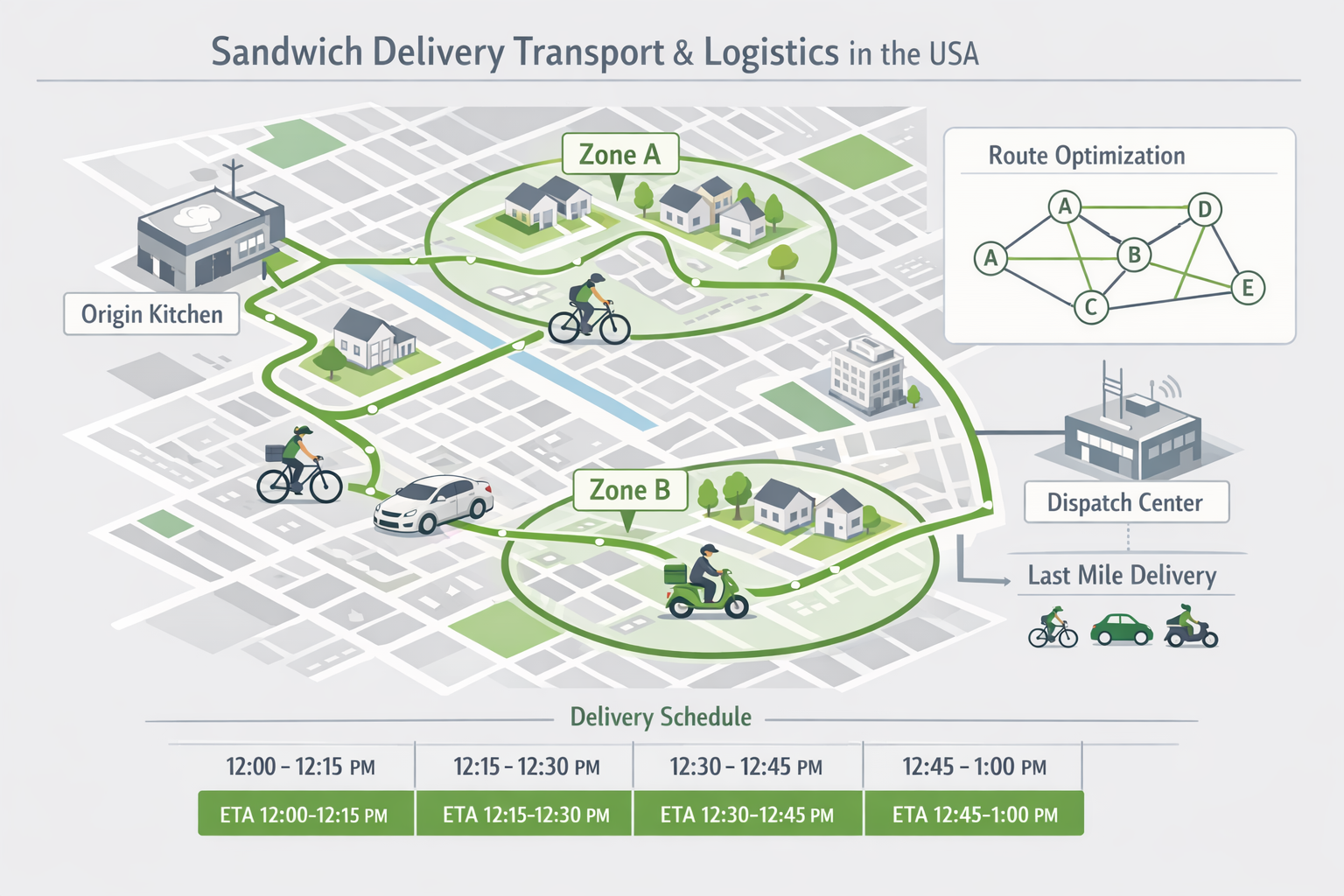
Algorithms calculate the fastest path between kitchen and customer, accounting for traffic, distance, order sequencing, and courier availability in real time across US city grids.
Digital dispatch systems match available couriers to incoming orders, track delivery progress via GPS, and provide estimated arrival times to customers and kitchen operators simultaneously.
The final segment of delivery β from the nearest transit point to the customer's specific address β is the most complex and cost-intensive phase of the entire sandwich transport system.
The diagram below illustrates how sandwich delivery transport systems are organized across a typical US urban area, showing origin kitchens, delivery zones, courier modes, and dispatch coordination.
Effective delivery route planning is the foundation of a successful sandwich transport system. Routes must balance speed, distance, food safety time windows, and courier capacity constraints β all while adapting dynamically to real-world conditions such as traffic, weather, and order surges.
Sandwich delivery operations in the USA define geographic service areas β known as delivery zones β around each kitchen location. These zones are typically drawn as radius-based circles (for example, a 2-mile or 5-mile radius from the kitchen) or as custom polygons that follow natural geographic boundaries such as major roads, rivers, or district lines. The shape and size of a delivery zone is determined by multiple factors: the maximum acceptable delivery time for food quality (typically 30β45 minutes for sandwiches), the density of the target customer population within the zone, the expected average order volume, and the number of couriers available at any given time.
Urban areas with high population density β such as Manhattan, downtown Chicago, or the San Francisco Financial District β can support smaller, tighter delivery zones because the number of orders per square mile is high enough to justify dedicated courier coverage. In lower-density suburban areas, delivery zones must be larger to capture sufficient order volume, which in turn increases average delivery times and places greater demands on thermal packaging to maintain food quality.
Modern sandwich delivery platforms use sophisticated route optimization algorithms β a variant of the Traveling Salesman Problem (TSP) and Vehicle Routing Problem (VRP) adapted for real-time urban delivery β to calculate the most efficient path for each courier. These algorithms take into account the GPS coordinates of the pickup location (the kitchen), the delivery address, current traffic conditions sourced from mapping APIs (Google Maps, HERE, or Mapbox), the estimated preparation time remaining for the order, the courier's current location and mode of transport, and any other active orders assigned to the same courier.
For platforms handling high order volumes, these calculations are performed in real time for hundreds of concurrent orders across an entire city. Machine learning models trained on millions of historical deliveries are used to predict preparation times, estimate traffic delays, and dynamically rebalance courier assignments as conditions change throughout a delivery shift. The output of the route optimization system is a turn-by-turn navigation instruction set delivered to the courier's mobile device, along with an estimated time of arrival displayed to the customer.
Food Safety Time Constraint: Route optimization for sandwich delivery is not purely a distance-minimization problem β it is also a time-constrained food safety problem. Every route calculation must ensure the total transit time keeps the sandwich within FDA-compliant temperature ranges. This adds a hard time limit to all route decisions, typically no more than 30β45 minutes from kitchen pickup to customer delivery for perishable sandwiches.
The United States sandwich delivery market employs a multi-modal courier fleet that varies by city density, geography, and delivery platform policy. Each mode of transport has distinct advantages and limitations that make it suitable for specific delivery contexts.
Bicycle delivery is the dominant mode in the densest urban cores of the USA, particularly in cities like New York City, Chicago, and San Francisco where vehicle traffic is severely congested and parking is prohibitively expensive or unavailable. Bicycle couriers can navigate bike lanes, cut through traffic, and lock up directly in front of delivery addresses β often achieving faster door-to-door times than motorized vehicles in high-density neighborhoods despite their lower maximum speed. The proliferation of e-bikes (electric-assist bicycles) has expanded the practical range of bicycle delivery in the USA, allowing couriers to cover larger territories and carry heavier loads without excessive physical fatigue. Many delivery platforms in the USA now actively recruit e-bike couriers and, in some cities, provide e-bikes to couriers as part of a platform-operated fleet program. Bicycle delivery produces zero direct emissions, aligning with the sustainability goals of food operations in environmentally progressive US cities.
Motorcycles and motor scooters occupy the middle ground of the US sandwich delivery courier fleet β faster than bicycles over longer distances and more maneuverable in traffic than full-sized cars. Scooter-mounted delivery boxes, particularly the rectangular hard-shell containers mounted on rear racks, provide excellent thermal insulation and structural protection for sandwich orders while maintaining the courier's ability to filter through traffic. In US states and cities with temperate climates and well-developed road networks β such as Los Angeles, Miami, and Houston β scooters and motorcycles are among the most efficient and cost-effective delivery modes available. Couriers using this mode typically cover delivery zones of 2β8 miles from the kitchen and can complete significantly more deliveries per shift than bicycle couriers operating over the same geographic area.
Automobile delivery is the most common mode of sandwich transport in suburban and exurban areas of the USA where population density is insufficient to support bicycle or scooter economics. Car-based couriers benefit from the ability to carry larger order volumes per trip, protection from adverse weather conditions β a significant factor in northern US cities during winter months β and access to a much larger geographic delivery radius than non-motorized alternatives. The primary disadvantages of car delivery in urban areas are traffic congestion, parking availability at both pickup and delivery locations, and the higher operating costs associated with fuel and vehicle maintenance. The rise of electric vehicles (EVs) in the US courier fleet is beginning to address the environmental and fuel cost concerns associated with car delivery, with several major delivery platforms offering EV incentives and priority dispatch to couriers operating electric vehicles.
Walking delivery is a niche but operationally significant mode in the most pedestrian-dense areas of the USA β primarily in Manhattan below 96th Street, the Chicago Loop, and the dense downtown cores of Boston and Washington DC. In environments where buildings are so closely packed that vehicle access is impractical and bicycle parking unavailable, walking couriers carrying insulated shoulder bags can actually outperform all other delivery modes for short-distance orders in the 0.1β0.5 mile range. Walking delivery is most common at lunchtime when office-dense neighborhoods generate high concentrations of orders within a very small geographic area, allowing a single walking courier to complete 6β10 deliveries within a few blocks without ever needing a vehicle.
The operational backbone of any sandwich delivery transport system is its dispatch and logistics infrastructure β the combination of technology, human coordination, and physical assets that orchestrates the movement of hundreds or thousands of orders daily.
Modern sandwich delivery dispatch systems operate as real-time, cloud-based platforms that simultaneously manage the kitchen-side order queue, the courier-side assignment system, and the customer-facing tracking interface. When a customer places a sandwich order, the dispatch system evaluates all available couriers within the delivery zone, ranks them by proximity to the kitchen and current load, and assigns the order to the optimal courier β typically within seconds of the order being confirmed. The assigned courier receives a push notification on their delivery app with the pickup address, order details, and navigation instructions to the kitchen. Simultaneously, the kitchen receives the order on its Kitchen Display System and begins preparation timed to the estimated courier arrival, minimizing the time the packaged sandwich waits at the counter before being picked up.
GPS tracking of couriers in real time allows the dispatch system to provide customers with live delivery tracking maps β a feature that has become a baseline expectation in the US market. The same GPS data feeds back into the route optimization engine, allowing it to update delivery time estimates dynamically as traffic conditions change or couriers experience unexpected delays.
The "last mile" β the final segment of the delivery journey from the nearest accessible point to the customer's exact delivery location β is widely recognized as the most difficult and expensive component of the entire sandwich transport system. In apartment buildings, office towers, and gated communities, the last mile can involve navigating complex building access systems, waiting for elevator service, finding the correct unit or desk among hundreds of options, and managing secure package handoff without the customer being immediately present at the door. These building access challenges are compounded in high-rise residential buildings, where a courier may need to interact with a doorman, use a call box system, or wait for building access permission before they can even begin the final segment of delivery.
The US food delivery industry has developed several technological solutions to last-mile challenges, including PIN-based contactless delivery verification (where customers confirm receipt via a code), photo-at-door delivery confirmation, and building-specific delivery instruction systems that couriers access through the delivery app. Some commercial property developers and residential building managers in the USA have begun installing dedicated food delivery pickup lockers in lobbies and mailrooms β temperature-controlled compartments where couriers deposit orders that customers retrieve at their convenience, eliminating the access and timing challenges of direct handoff delivery.
| Courier Mode | Typical Speed | Optimal Zone Radius | Weather Impact | Best US Markets |
|---|---|---|---|---|
| Bicycle (standard) | 8 β 14 mph | 0.5 β 2 miles | High | NYC, Chicago, SF, Boston |
| E-Bike | 15 β 20 mph | 1 β 4 miles | Moderate | Most major US cities |
| Motor Scooter | 20 β 35 mph | 2 β 6 miles | Low | LA, Miami, Houston, NYC |
| Motorcycle | 25 β 45 mph | 3 β 10 miles | Low | Nationwide |
| Automobile (car) | 15 β 40 mph (varies) | 3 β 15 miles | Minimal | Suburban / exurban USA |
| On-Foot (walking) | 3 β 4 mph | Up to 0.5 miles | Moderate | Manhattan, Chicago Loop |
The US sandwich delivery transport landscape is undergoing rapid technological evolution. Several emerging systems have moved from experimental to early commercial deployment and are expected to reshape last-mile food delivery logistics within the coming decade.
Sidewalk delivery robots β compact, wheeled autonomous vehicles operating on pedestrian pathways β are currently deployed in several US college campuses and suburban neighborhoods. Companies such as Starship Technologies, Kiwibot, and Serve Robotics operate fleets of these devices that navigate autonomously using onboard cameras and sensors, delivering orders over short distances without a human courier. The robots carry insulated compartments suitable for sandwich delivery and communicate their arrival to customers via app notification.
Aerial drone delivery for food has advanced significantly in the USA, with FAA-approved commercial drone delivery operations now active in several states including Texas, Virginia, and Utah. Drone delivery offers the potential to bypass surface traffic entirely, achieving delivery times of under 10 minutes for orders within a 2β3 mile radius of a launch facility. Current operational constraints include FAA airspace regulations, payload limits (typically under 5 pounds), weather restrictions, and the need for landing zone clearance at the delivery address.
Temperature-controlled smart locker systems installed in residential buildings, office lobbies, and transit hubs represent a growing segment of the US food delivery infrastructure. These systems allow couriers to deposit food orders securely without requiring the customer to be present at delivery time, and notify customers via app when their order is ready for pickup. Some locker systems maintain separate temperature zones for hot and cold items, making them suitable for a wide range of food types including sandwiches with temperature-sensitive ingredients.