How wrapping materials, insulation systems, and temperature control technologies preserve sandwich quality from kitchen to customer in the USA.
Packaging is the bridge between the preparation kitchen and the delivery vehicle. A perfectly assembled sandwich can be ruined by inadequate packaging — soggy bread from condensation, wilted lettuce from heat exposure, or structural collapse from improper containment. In the United States, sandwich packaging must simultaneously satisfy food safety regulations, maintain sensory quality, support brand presentation, and increasingly, meet sustainability standards.
Maintaining safe food temperatures during transit is the primary function of delivery packaging. Both hot and cold sandwiches require dedicated thermal management systems appropriate to their specific temperature range requirements.
Controlling moisture — both preventing excessive condensation and retaining appropriate humidity — is essential to preserving bread texture and vegetable crispness throughout the delivery window.
Packaging must hold the sandwich in its intended shape and prevent ingredient displacement, compression, or spillage as the package moves through the delivery process from kitchen to doorstep.
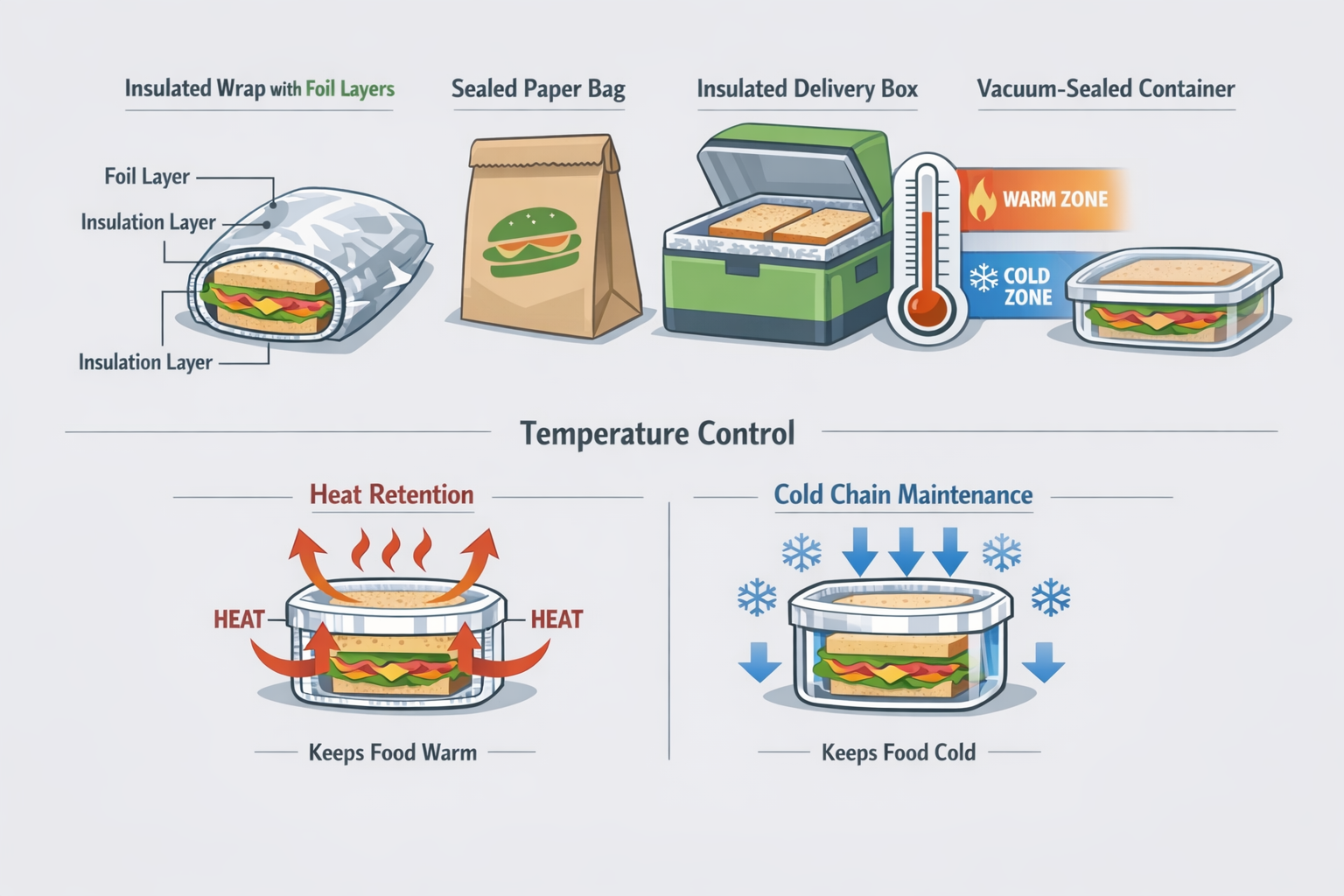
The diagram below illustrates the four principal sandwich packaging formats used in US delivery operations, along with their temperature control mechanisms.
The first layer of packaging applied directly to the sandwich is known as the primary wrap. It protects the food from direct contamination, helps retain moisture balance, and provides the initial structural containment of the sandwich. Several primary wrapping methods are used across the US sandwich delivery industry.
Deli paper — sometimes called butcher paper or sandwich paper — is one of the most traditional and widely used primary wrap materials in the US sandwich industry. It is a grease-resistant, food-grade paper that allows minimal breathability while protecting the sandwich surface from direct contact with outer packaging. Waxed paper provides a slightly higher moisture barrier than plain deli paper and is particularly useful for sandwiches with wet ingredients such as tomatoes or oil-dressed vegetables. The paper wrap also serves a practical function during eating — customers can unwrap the sandwich progressively, using the paper as a hand barrier. From a sustainability standpoint, both deli paper and waxed paper are compostable under the right conditions, making them a preferred choice for environmentally conscious food operations in states like California, New York, and Washington that have active composting infrastructure.
Aluminum foil and foil-laminate wraps provide superior thermal retention compared to paper alternatives, making them the standard choice for hot sandwiches destined for delivery. Foil reflects infrared radiation and slows conductive heat loss, maintaining the internal temperature of a wrapped sandwich significantly longer than paper alone. Foil-laminate materials — which combine a metallic reflective layer with a food-grade plastic or paper backing — offer enhanced moisture barrier properties while retaining the thermal advantages of pure foil. These materials are commonly used for grilled sandwiches, paninis, and toasted hoagies where maintaining warmth during a 20–45 minute delivery window is critical to customer satisfaction. One limitation of foil wrapping for delivery purposes is that it does not allow visual inspection without unwrapping, which can complicate quality control at the handoff point between kitchen and courier.
After the primary wrap is applied, many sandwich delivery operations place the wrapped sandwich into a sealed paper bag or kraft bag as a secondary containment layer. These bags provide additional structural support, prevent the primary wrap from unfolding during handling, and serve as a labeled outer package where order information, allergen notices, and branding are printed or applied via sticker. In the USA, the growth of third-party delivery platforms such as DoorDash, Uber Eats, and Grubhub has accelerated the adoption of tamper-evident sealing on paper bags — typically in the form of adhesive seals or heat-sealed closures that show visible evidence of interference. This tamper-evident packaging practice helps build consumer confidence in the integrity of delivered food and is becoming a de facto industry standard in major US cities.
For premium or specialty sandwiches — particularly those with elaborate toppings, open-face constructions, or accompaniments such as side salads — rigid clamshell containers made from PET plastic, recycled paperboard, or compostable sugarcane fiber (bagasse) are used. These containers protect the sandwich from compression and allow it to be presented in an attractive, restaurant-quality format when opened. Transparent-lid clamshells have the additional advantage of allowing visual confirmation of the sandwich contents without opening — a feature valued by quality-conscious consumers and useful for order verification. Many US states and cities have enacted or proposed restrictions on single-use plastic clamshells, driving a significant shift toward compostable and recyclable alternatives. Cities such as San Francisco, Seattle, and New York City have been at the forefront of packaging sustainability mandates that directly affect food delivery operators.
Beyond the primary and secondary wrapping of individual sandwiches, the delivery packaging system includes a layer of thermal management designed to maintain safe food temperatures across the entire delivery window — from the moment food leaves the kitchen to the moment it is received by the customer.
The insulated delivery bag is the workhorse of the US sandwich delivery temperature control system. These bags are constructed with multiple functional layers: an outer fabric shell (typically nylon or polyester) for durability and water resistance, a middle layer of insulating foam (polyurethane, EPE foam, or reflective PEVA lining) that slows heat transfer, and a food-safe inner lining that is easy to wipe clean. High-quality insulated delivery bags are rated for maintaining hot food above the FDA danger zone threshold of 140°F (60°C) or cold food below 40°F (4°C) for 30–90 minutes depending on ambient temperature, bag quality, and how fully the bag is loaded.
The thermal efficiency of an insulated bag is directly affected by the fill level — a fully loaded bag retains temperature significantly better than one that is only partially filled, because the food items themselves act as thermal mass. Some delivery operations use filler inserts or dividers to occupy empty space in the bag when order volumes are low, improving overall temperature retention.
For longer delivery windows or premium sandwich operations, active temperature management systems are employed. These include gel packs and dry ice inserts that are placed in the delivery bag alongside food packages to provide active cooling, maintaining cold-chain integrity for sandwiches containing temperature-sensitive ingredients such as raw vegetables, mayonnaise-based proteins, and fresh cheese. Hot packs — disposable chemical heat packets or reusable microwavable inserts — are used in some operations to supplement the thermal retention of insulated bags for hot sandwich deliveries.
In the commercial catering and large-order sandwich delivery segment, heated and refrigerated delivery vehicles are used. These are vans or trucks fitted with onboard temperature-controlled compartments that maintain consistent temperatures throughout an entire delivery route. While this level of infrastructure is primarily associated with catering operations and grocery delivery rather than individual sandwich delivery, the technology is increasingly being explored by delivery-focused restaurant chains as a premium service differentiator.
FDA Temperature Danger Zone: According to US FDA Food Code guidelines, perishable foods including sandwiches containing proteins, dairy, and mayonnaise must not remain in the temperature danger zone of 40°F – 140°F (4°C – 60°C) for more than 2 hours cumulatively. This is the primary constraint that defines maximum acceptable delivery times for food safety compliance.
| Packaging Material | Thermal Performance | Moisture Barrier | Sustainability | Typical Use Case |
|---|---|---|---|---|
| Deli / Waxed Paper | Low | Moderate | Compostable | Cold deli sandwiches |
| Aluminum Foil Wrap | High | High | Recyclable | Hot toasted sandwiches |
| Foil-Laminate Wrap | Very High | Very High | Limited | Premium hot delivery |
| Kraft Paper Bag | Low | Low | Recyclable | Secondary containment |
| PET Clamshell | Moderate | High | Recyclable (#1) | Premium / open-face |
| Bagasse Clamshell | Moderate | Moderate | Compostable | Eco-conscious operations |
| Insulated Delivery Bag | Very High | High | Reusable | All delivery types |
In the United States, sandwich delivery packaging must carry specific informational labels to comply with federal and state food safety regulations, allergen disclosure laws, and in some jurisdictions, nutritional information requirements.
Under US federal regulations, food packaging for commercially prepared sandwiches must include the name of the food product, a list of ingredients in descending order of predominance by weight, allergen declarations identifying any of the nine major food allergens (milk, eggs, fish, shellfish, tree nuts, peanuts, wheat, soybeans, and sesame — the last added by FASTER Act in 2023), net weight or quantity, and the name and address of the producing establishment.
For delivery operations using third-party platforms, order confirmation labels generated by the platform or the kitchen's point-of-sale system are typically applied to the outer packaging. These labels include the customer name, order number, item description, special instructions, and in many cases a QR code linked to the digital order record. Some platforms also require nutrition facts panels on items sold through their marketplace, though specific requirements vary by platform policy and jurisdiction.
Tamper-evident packaging has become an industry-wide standard in the US sandwich delivery market following high-profile concerns about food safety and order integrity on delivery platforms. The most common tamper-evident mechanism in sandwich delivery is the use of adhesive stickers that bridge the opening of the outer bag — typically printed with the restaurant or platform brand — that must be visibly torn or broken to access the contents.
Some operations use heat-sealed closures, zip-lock bags with security locks, or tamper-evident tape on clamshell containers. While no federal regulation currently mandates tamper-evident packaging for all restaurant delivery in the USA, the practice is required by the terms of service of several major delivery platforms and is strongly recommended by state health departments. Consumer awareness of tamper evidence has increased significantly, making it a de facto requirement for maintaining customer trust and brand reputation in the competitive US delivery market.